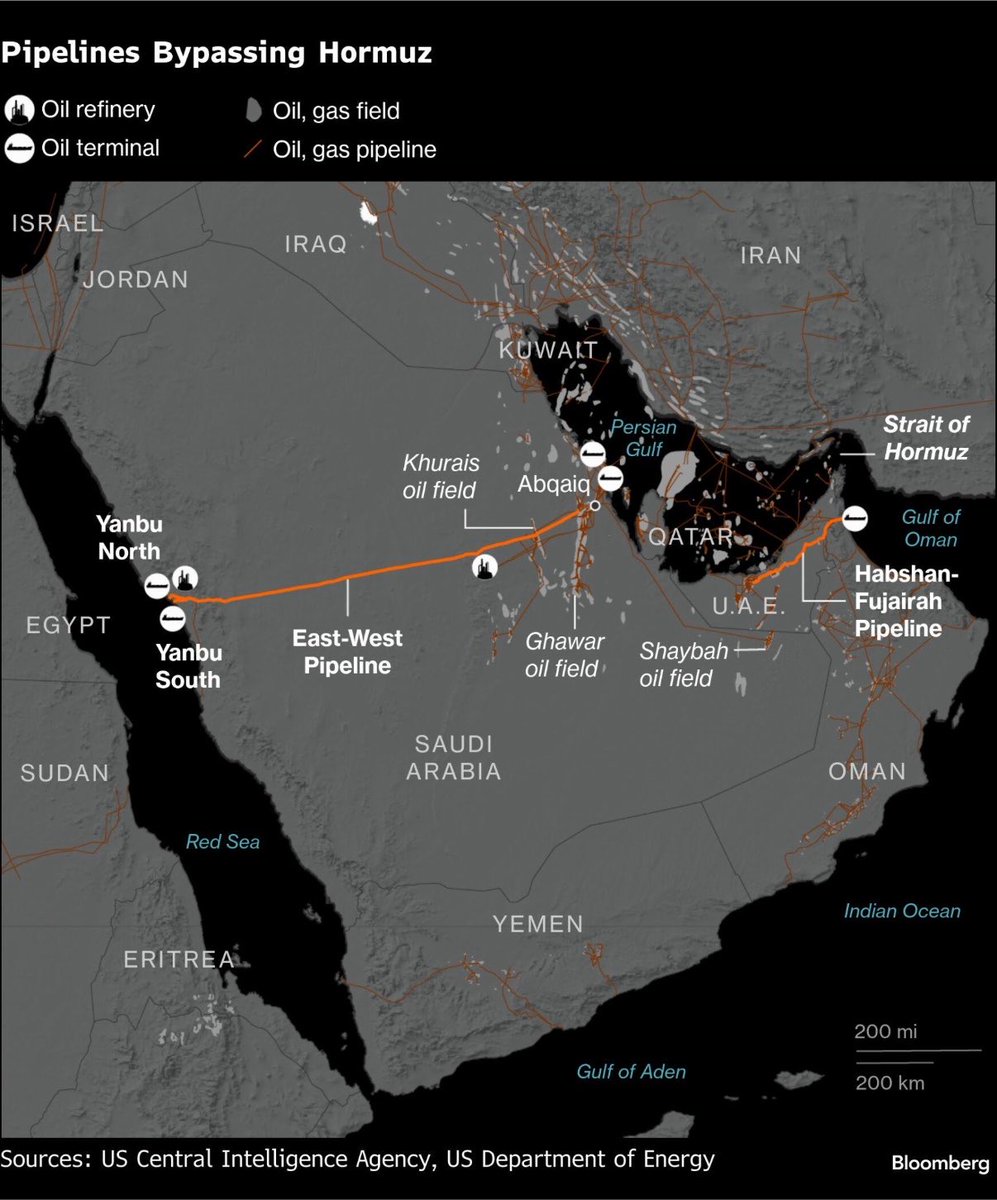
Treasury Secretary Scott Bessent says pipelines could divert 50–70% of Hormuz energy traffic within two years, making the strait almost “irrelevant.”
An analysis posted by @AlexiaNoel94927 and reshared by Sh1n highlights the massive engineering gap behind this claim:
Existing bypasses:
- Saudi East–West pipeline: Persian Gulf fields → Yanbu on the Red Sea, rated at 7 million barrels/day. Actual exports are constrained by refineries, storage and Yanbu’s loading terminals.
- UAE Habshan–Fujairah pipeline: Abu Dhabi → Gulf of Oman, about 1.8 million bpd. A second line planned for 2027 could raise combined capacity to roughly 3.6 million.
- Iran’s Goreh–Jask pipeline: Iranian fields → Gulf of Oman, but effective capacity is only about 300,000 bpd.
- Iraq–Türkiye pipeline: Kirkuk → Ceyhan, currently carrying a fraction of its 1.5 million-bpd theoretical capacity. Extending it to southern Iraq remains a proposal, not finished infrastructure.
Hormuz previously carried nearly 20 million bpd of oil. The IEA estimates today’s genuinely available bypass capacity at only 3.5–5.5 million bpd. Diverting 50–70% would require roughly 10–14 million bpd, plus new pumping stations, storage tanks and export terminals.
The biggest flaw is LNG: Qatar ships around 9.3 billion cubic feet per day through Hormuz. LNG cannot simply be pumped through an oil pipeline. A replacement would require enormous gas pipelines across several countries or entirely new liquefaction and export terminals outside the Gulf.
Reducing dependence on Hormuz is possible. Making it irrelevant by 2028 is not a construction plan yet. It is a political prediction with a very large engineering gap.


Discussion
Comments
No approved comments yet.