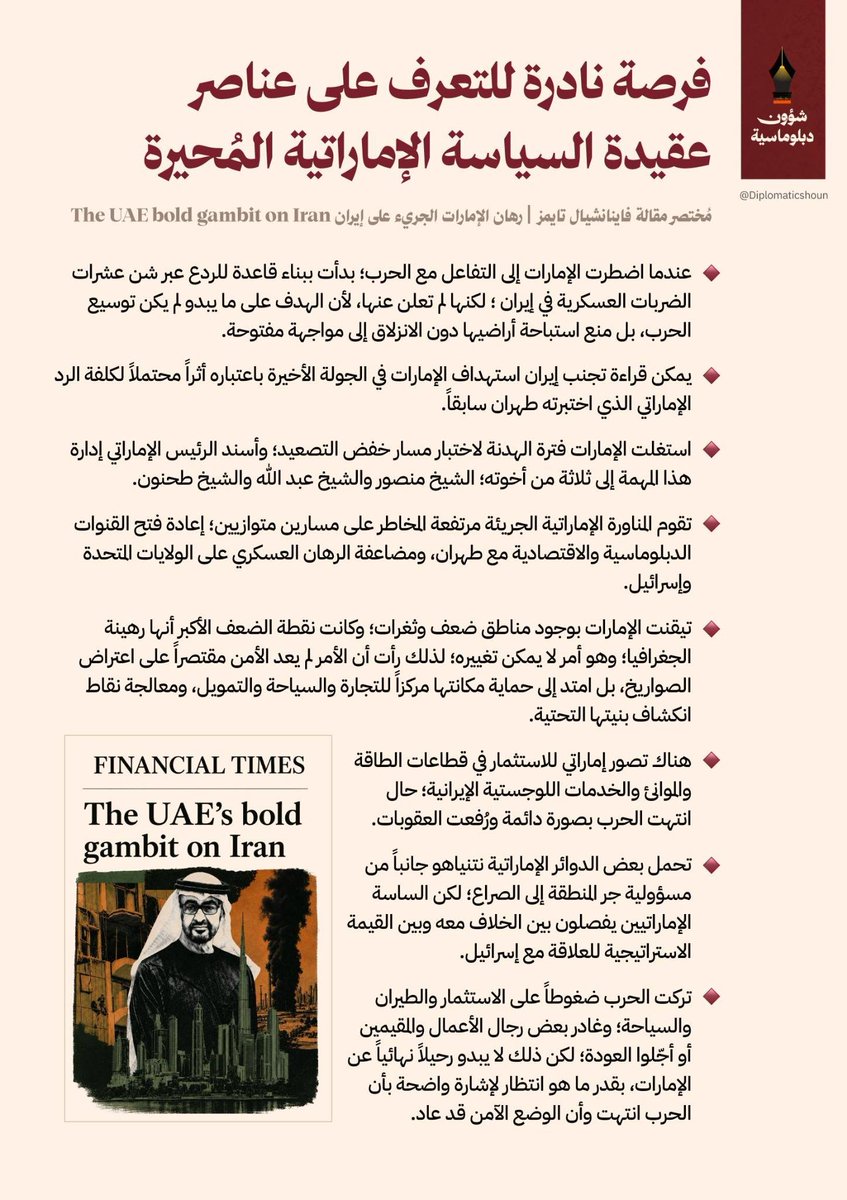
The following analysis of the UAE's political doctrine was posted on X by @DiplomaticShoun, retweeted by @hey_itsmyturn.
Financial Times published a striking article today that quickly became material for two completely contradictory readings. Supporters of UAE policies saw it as evidence of skill in recalibrating paths whenever facts change, while critics considered it a revelation of a high-risk policy driven by interests more than constants.
The article gave each side enough to anchor their narrative, so we decided to step in: we will deconstruct this article from a broader geopolitical perspective in an attempt to arrive at an answer that helps identify the elements of the puzzling UAE political doctrine as described in it.
- Constant Path and Side Roads: Critics see UAE's policies as ever-shifting, thus hard to trust. Supporters view this ability to recalibrate and redirect when facts change as the ultimate realism, demonstrating efficiency and awareness of the region's rapid changes. Tracing UAE's moves over the past years, maneuvering and recalibration to improve response appears to be a recurring pattern in its political doctrine. It transitioned from direct military intervention in Yemen in 2015 to reducing forces and redeploying in 2019. The same logic appeared in Syria, where it supported the opposition at the start of the crisis then reopened its embassy at the end of 2018, and now it engages positively with the new Syrian regime contrary to Assad's. Similarly with Turkey, the relationship shifted from tension to a broad economic partnership. Some might explain this as the ability to separate fixed interests from flexible tools, granting it high maneuverability, though it sometimes makes policies unpredictable and untrustworthy to other parties.
- Birth of Direct Deterrence: The article argued that Iran's failure to target the UAE in the current round is a result of the UAE activating deterrence by launching military operations inside Iran. Critics say the UAE has no right to do so; supporters say it is fully justified in response to Iranian violations of UAE sovereignty. However, the more important point is that the UAE's military operations inside Iran represent the birth of a new element in its political doctrine that did not previously exist. Traditional deterrence existed but was not activated; this may represent the birth of managed direct deterrence. The UAE's goal from these operations appears to be lowering escalation while raising the cost of any future attack.
- Economy Constrains Policy or Policy Protects Economy? Critics see the damage to the UAE economy as an opportunity to undermine its foreign policy capacities across the region. Supporters argue that the war did not leave such a huge impact; rather, the war had the merit of pushing the UAE to make a bold and courageous decision: liberating its political doctrine from constant anxiety about potential negative repercussions on the economy. It seems the UAE decided to break this shackle.
- The Geography Gap: Critics say the war exposed UAE's vulnerabilities, foremost geography. Once the Strait of Hormuz is closed and restrictions increase on land crossings, difficulties emerge in the movement of people and trade. Supporters say the UAE did not deny weaknesses and gaps, so it rushed to re-engineer geography by building a new pipeline, two ports in Fujairah, and enhancing protection of strategic facilities. These moves, in political literature, are classified as tools that reduce the opponent's ability to blackmail.
- Dubai and Abu Dhabi: Duality or Integration? Dubai and Abu Dhabi are often invoked in analyses of UAE policies. Critics frame them as rivals on different paths, while supporters see them as complementary engines of the political doctrine. Dubai hosts a large Iranian community; both share sizable investments and economic ties with Iran. The UAE's deterrence behavior in military operations reflects awareness of the risks of escalation to the Dubai model, yet this level of deterrence was necessary to keep the model alive.
- Moving Alone Sometimes, Early Sometimes: Critics say the UAE often breaks regional consensus, implying a hostile outlook toward its neighborhood. Supporters argue that the fragility of this region, rapid changes, incohesive alliances, and dominance of narrow interests require the ability to decide to move alone or outside consensus, believing this behavior protects against future risks and helps seize various opportunities before competition intensifies.
⚠️ Our Strategic Assessment Summary
Despite our attempt to deconstruct the elements of the UAE political doctrine as presented in the FT article, we seem to have also fallen into the trap of perplexity. The region's complexities, entanglements, and shifts have driven, or perhaps forced, the UAE to build a political doctrine based on managing contradictions—a capability that may reflect efficiency and flexibility, but does not necessarily mean these contradictions can be contained without cost. History may ease this perplexity: it tells us that contradictions are an inherent element in international relations; they cannot be ended, only managed, with the acceptance that their cost may sometimes rise—a logic that seems deeply rooted in the UAE's political doctrine.
On another side, the article reflects another aspect of the UAE's political doctrine: it moves within extremely wide and contradictory circles of influence, alliances, and enmities, which may make its policy more influential but also more prone to miscalculation in a volatile and unstable region. It seems UAE calculations see that losses from some miscalculations remain acceptable and less costly than the losses of staying in place, or insisting on not separating issues and crises.

Discussion
Comments
No approved comments yet.