The short version
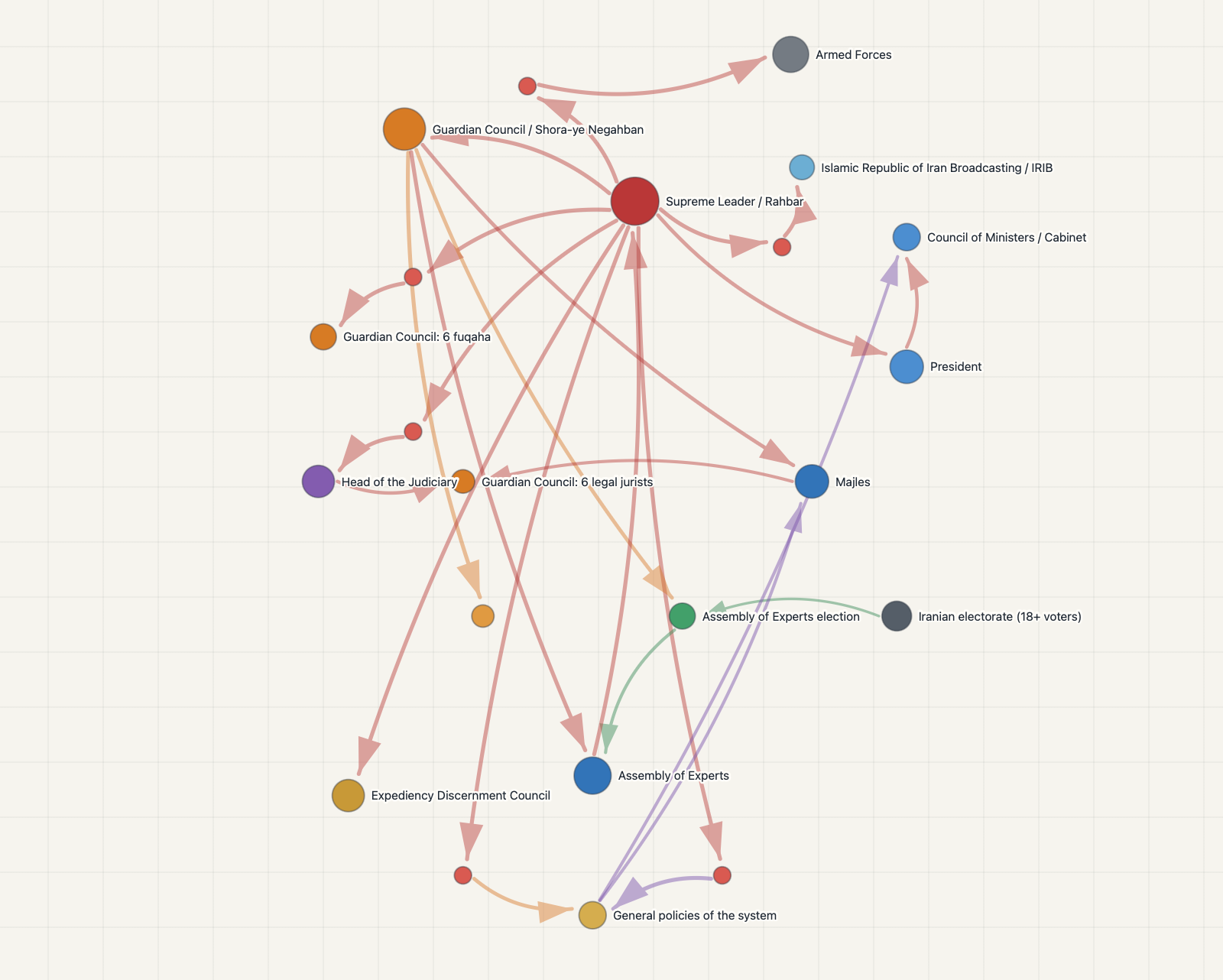
The Islamic Regime in Iran does not work like a normal republic where power moves upward from voters and then stays accountable to voters. It works like a loop.
At the center of that loop is the Supreme Leader. The Assembly of Experts formally chooses and can remove the Supreme Leader. But candidates for the Assembly of Experts are filtered before the public ever sees the ballot. The body doing the filtering is the Guardian Council. And the Guardian Council is structurally tied back to the Supreme Leader.
That is the point. The system is not accidentally circular. The circle is the design.
The power loop
Here is the clean version:
- The Supreme Leader appoints six Islamic jurists of the Guardian Council.
- The Supreme Leader appoints the Head of the Judiciary.
- The Head of the Judiciary nominates the six legal jurists of the Guardian Council.
- Parliament approves those six legal jurists, but Parliament’s own candidates are also vetted by the Guardian Council.
- The Guardian Council vets candidates for national elections, including the Assembly of Experts.
- The Assembly of Experts formally selects and can dismiss the Supreme Leader.
So when people say, “But the Assembly of Experts chooses the Leader,” the missing part is: who gets to become a candidate for that Assembly?
And when people say, “But people vote for the Assembly,” the missing part is: who filters the ballot before people vote?
The answer keeps coming back to the same place.
The Guardian Council is the gate
The Guardian Council is not just an advisory body. Under Iran’s constitution, it reviews legislation, interprets the constitution, and supervises national elections. In practice, that supervision has been interpreted as approbatory supervision: not just watching elections, but approving or rejecting candidate qualifications before the election.
That means the public vote happens after the gate has already been built.
This matters for the presidency, Parliament, and the Assembly of Experts. Voters are not choosing from an open national field. They are choosing from a field filtered by an institution half directly appointed by the Supreme Leader and half routed through a judiciary chief appointed by the Supreme Leader.
This is why calling the system “elected” without explaining the filter is misleading.
The Assembly of Experts problem
On paper, the Assembly of Experts is the body that gives the system accountability at the top. It selects the Supreme Leader and can remove him if he loses the required qualifications.
But on the ground, Assembly candidates are not simply free to run. They pass through the same national vetting structure. The Guardian Council’s role over national elections, and the separate qualification process for Assembly candidates, means the body that is supposed to supervise the top of the system is itself shaped before voters touch it.
So the alleged check on the Supreme Leader is filtered by institutions connected to the Supreme Leader.
That is not oversight. That is a controlled feedback loop.
The president does not break the loop
The president can win a popular vote, but the presidency is still boxed in.
The Supreme Leader sets general policies of the system, commands the armed forces, appoints the Head of the Judiciary, appoints the head of state broadcasting, confirms Supreme National Security Council decisions, and signs the decree formalizing the elected president. The president is responsible not only to voters and Parliament, but also to the Supreme Leader.
So even when the presidency changes hands, the core of power does not.
The executive branch can move paperwork. It can negotiate inside limits. It can manage ministries. But the hard levers stay above it: security, judiciary, state media, constitutional interpretation, candidate vetting, and general policy.
Why this is a dictatorship
A dictatorship is not only a man with a uniform and a giant portrait. Sometimes it is a constitutional machine that lets people vote inside a cage, then points to the cage and calls it democracy.
Iran’s Islamic Regime has elections, but elections do not automatically make a system democratic. The real question is whether power can be replaced, challenged, and held accountable by the public.
In this system, the public enters late. The ballot arrives after vetting. The elected bodies operate under unelected review. The body that supposedly chooses the Supreme Leader is itself filtered. The Guardian Council sits at the gate. The Guardian Council loops back to the Supreme Leader.
That is the mechanism.
Sources
- Constitution of the Islamic Republic of Iran, especially Articles 91-99, 107-112, 113-118, 122, 157, 175-177: constitution text
- Guardian Council interpretation of Article 99 as approbatory supervision: Iran Data Portal
- Assembly of Experts candidate criteria and Guardian Council vetting role: The Washington Institute
Interactive map
Open the separate interactive map here: How “Supreme Leader” controls the power loop in Iran
Discussion
Comments
No approved comments yet.